It is your first date night or work shift away from home since your baby was born. You have briefed the babysitter, stocked the refrigerator with pre-measured bottles, and laid out emergency contacts on the kitchen island. But as you stand by the front door with your coat on, an awkward modern parenting dilemma arises: How do you give the babysitter access to your nursery monitor without handing over your primary smartphone, revealing your master home Wi-Fi password, or compromising your private cloud security?
Traditional hardware baby monitors force you to leave behind a clunky handheld parent unit with a dying lithium battery. Proprietary Wi-Fi smart cameras (like Nanit or Owlet) require grandparents or babysitters to download heavy apps, create permanent accounts, and gain perpetual access to your nursery camera feed – complete with access to historical video recordings and sensitive household telemetry. Learning how to share baby monitor access safely is vital to protect your family's digital privacy while ensuring your child receives attentive, responsive supervision.
In this cybersecurity and childcare safety guide, we break down the severe privacy vulnerabilities of traditional baby monitor access sharing, outline essential security rules for secondary caregivers (babysitters, nannies, and grandparents), examine role-based access control architecture, and explain how Baboo delivers secure, ephemeral, peer-to-peer monitor sharing without permanent account creation.
The Hidden Privacy Risks of Sharing Traditional Monitor Feeds
When parents carelessly share login credentials for commercial nursery cameras, they inadvertently open severe digital vulnerabilities in their household:
- Master Credential Sharing: Writing your primary cloud camera username and password on a sticky note for a date-night babysitter means that caregiver has unrestricted, perpetual access to your camera feed from their personal phone – even after they leave your home.
- Perpetual Remote Snooping: Cloud-connected smart monitors that route feeds through centralized servers allow authorized accounts to log in from anywhere in the world at any time. An ex-nanny or casual babysitter could theoretically view your master bedroom or living room cameras weeks later.
- Access to Historical Video Archives: Many commercial cameras store days of 24/7 video in the cloud. Inviting a caregiver to your account often grants them the ability to scrub through private family moments recorded in your home.
- Local Network Vulnerabilities: Giving out your master Wi-Fi password to temporary caregivers allows any compromised personal device they connect to potentially scan and access other smart devices on your local network.
| Monitor Architecture | Caregiver Setup Required | Security & Privacy Level | Revocation Mechanism | Risk of Unauthorized Snooping |
|---|---|---|---|---|
| Hardware Parent Unit (FHSS) | Physically hand over receiver | Low physical security (lost/broken unit) | Take back unit physically | Zero remote access, but zero range outside house |
| Commercial Cloud Smart Camera | Caregiver creates permanent account; email invite | Poor (perpetual access; cloud storage risks) | Manual administrative deletion in app settings | High; caregiver can view feed from anywhere indefinitely |
| P2P Ephemeral Access (Baboo) | Scan dynamic QR code or open browser link | Military-Grade (Direct WebRTC encryption) | Instant 1-click session kill / auto-expires | Zero; no cloud recordings, no persistent accounts |
5 Non-Negotiable Security Rules for Sharing Monitor Access
Before granting any secondary caregiver access to your infant's video stream, implement these pediatric privacy protocols:
- Rule 1: Enforce Role-Based Ephemeral Permissions: Never share primary administrator credentials. Secondary caregivers should only receive temporary, view-only access that expires automatically when their shift concludes.
- Rule 2: Restrict Access to Live Feed Only: Ensure secondary caregivers cannot view video history, download recordings, or adjust camera motor pan-and-tilt angles into private household areas.
- Rule 3: Use a Dedicated Guest Wi-Fi Network: If caregivers need Wi-Fi access, connect their devices to a dedicated, isolated guest network that cannot communicate with your home automation hubs or network-attached storage.
- Rule 4: Always Notify Caregivers Transparently: Inform nannies and babysitters explicitly that audio and video monitoring is active in nursery spaces. Respect childcare privacy by never placing cameras in caregiver bathrooms or private bedrooms (review our legal guide to nanny cam laws).
- Rule 5: Rotate Access Codes After Every Shift: If using pairing codes or shared links, revoke and regenerate them immediately after the caregiver leaves.
How Baboo Delivers Zero-Trust Caregiver Access
Baboo was engineered from the ground up on a zero-trust, peer-to-peer security architecture that makes sharing monitor access safe, effortless, and temporary:
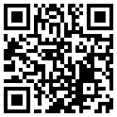
- No Permanent Account Creation: Babysitters and grandparents do not need to register accounts, share email addresses, or download bulky apps. They can simply scan a pairing code or access the live feed securely in any web browser at /app/.
- Direct End-to-End Encrypted WebRTC: Video and audio stream directly from the camera device (your nursery iPhone running iOS 17+) to the caregiver's device via local Wi-Fi or encrypted WebRTC. Streams never pass through or get saved on third-party cloud servers.
- Instant One-Tap Access Revocation: The moment you return home, a single tap on your primary device instantly terminates the session, severing all connections immediately.
- Multi-Platform Caregiver Support: Because the viewer runs reliably in web browsers, babysitters can view the feed on their iPhone, iPad, Mac, or laptop without hardware friction.
Is it legal to have a baby monitor watching a babysitter?
Should I tell our babysitter that we have a baby monitor?
Can grandparents watch the baby monitor from another state?
What happens if a babysitter's phone is lost or stolen with monitor access?
Can I use an old iPad as a dedicated monitor screen for the babysitter?
Sources
- Consumer Privacy and Cybersecurity Guidance for Smart Home Nursery Devices – Federal Trade Commission (FTC)
- Peer-to-Peer WebRTC Encryption Specifications and Security Best Practices – WebRTC Security Working Group
- Domestic Surveillance and Legal Guidelines for In-Home Childcare – U.S. Consumer Product Safety Commission
- Childcare Safety and In-Home Caregiver Monitoring Standards – American Academy of Pediatrics (AAP)